

Victorian property sales changes from October 2026: What agents need to know
A practical overview of the new property sales and underquoting requirements, key dates and what Victorian agencies should prepare for.


7 min read

Australian real estate agents and conveyancers: get answers to the most common AML Tranche 2 compliance questions. From AUSTRAC enrolment to CDD, VOI, and what happens at auction — covered in plain English.

NB: This post contains all the question asked during the Forms Live and PropTech Australia webinar on Tranche 2 AML compliance [link to webinar]. They’re organised by topic so you can find what you need quickly, and return to it as questions come up in your agency.
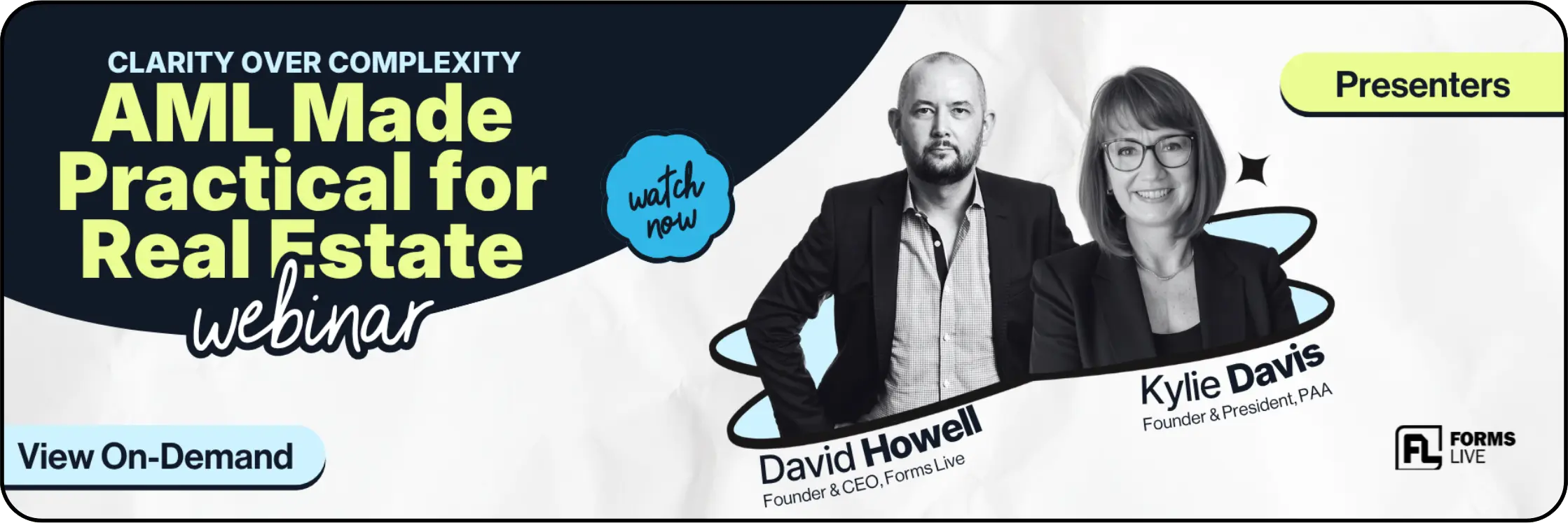
Forms Live founder and CEO David Howell joined Kylie Davis from PropTech Guru and PropTech Australia for a practical session on how new Anti-Money Laundering (AML) regulations will affect Australian real estate professionals, and how Forms Live is working to make compliance as seamless as possible.
The central message: AML compliance is mandatory. The disruption to your business is optional.
Watch the webinar recording now
Real estate isn’t being singled out. Tranche 2 covers a number of industries, including accounting, conveyancing, and precious gems. Between 2019 and 2024, over $720 million worth of real estate was seized by the government due to money laundering and crime-related transactions, so there is a real and documented risk. These regulations are about reducing that risk for agents and the broader community and bringing Australia into line with global standards that countries including New Zealand have already adopted.
Isn’t AML compliance more than the responsibility of banks and conveyancers? Banks and conveyancers have their own independent obligations, but agents have direct client relationships and transaction knowledge that provides a different type of visibility. There may be behaviour or information that an agent identifies that a bank or conveyancer simply would not see. That’s part of the rationale for extending AML obligations to Tranche 2.
It’s also worth noting that most buyers will have already gone through similar processes with their bank or mortgage broker, so the experience should feel familiar to them.
Has the government run a public awareness campaign about these changes? AUSTRAC has published guidance, but general awareness among buyers and sellers remains low. This is one reason it’s worth agents being prepared to explain the process simply and matter-of-factly, by framing it as a standard regulatory requirement, similar to what buyers already go through with their lender.
When did AUSTRAC enrolment open?
AUSTRAC enrolment opened on 31 March 2026. If you haven’t enrolled yet, now is the time. The period between enrolment and 1 July 2026 is when you should be getting your policies, procedures, and staff training in place.
Do we have to enrol with AUSTRAC?
Yes. All agencies providing designated services, which includes real estate sales, must enrol with AUSTRAC. Enrolment is now open. [add enrolment link here]
Does this apply to properties already on the market, or only new listings from 1 July?
The Customer Due Diligence (CDD) obligations apply from 1 July 2026. Properties already listed but where contracts are entered into on or after 1 July will need to go through the CDD process. We recommend confirming the specific treatment of pre-commencement contracts directly with AUSTRAC or your legal adviser.
Are there templates available to help us get started?
Yes. AUSTRAC has released a starter pack with templates for policies and procedures that you can adapt to your business. Most are straightforward, and cover things like cash deposit limits and accepted payment types. The starter pack is available for free download at www.austrac.gov.au.
One of our integration partners, easyAML [insert affiliate link here], also has policies and procedures built into their platform and is currently offering free registration until July. This is a good way to get across what you need to do as either a principal or a selling agent.
What is the difference between CDD and PDD?
CDD stands for Customer Due Diligence, and it involves the day-to-day process of verifying your buyers and sellers, which begins on 1 July 2026.
PDD stands for Personnel Due Diligence and is the internal work of setting up your business policies, procedures, and staff training.
PDD needs to be in place before July, so that when CDD begins, your team is ready.
What red flags should agents look out for?
As a business owner or principal, you set your own risk thresholds as part of your policies and procedures. A common example is not accepting physical cash deposits over a certain amount, as the higher the cash amount, the higher the risk. Another example is not accepting cryptocurrency. These are the types of policies you document upfront and then simply implement day-to-day.
Is there funding support for small businesses to cover compliance costs?
There is no government compensation or funding for compliance costs. Like other regulatory requirements, businesses are responsible for meeting their own obligations. That said, easyAML is currently offering free registration until July, which is a useful starting point for smaller businesses.
Is there a minimum business size for these requirements?
No. All agencies providing designated services must comply, regardless of size. However, for selling agents, the day-to-day impact is minimal since it’s predominantly a one-click process within Forms Live. The heavier compliance work sits with the principal and compliance officer, which will be covered in a follow-up webinar.
What is VOI and how does it work in Forms Live?
VOI stands for Verification of Identity and is the process of confirming that the person you’re dealing with is who they say they are. In Forms Live, the agent initiates a VOI request with a single click. The customer then completes the process on their own device, using a mobile phone, by uploading their driver’s licence, passport, or Medicare card. Liveness checks are built in to prevent fraud. The result comes back to you confirming that the identity has been verified.
Can you walk us through the buyer verification process step by step?
When a buyer makes a successful offer or wins at auction, you initiate the CDD process through Forms Live with a single click. The buyer receives a request on their device and completes verification by uploading a government-issued ID and completing a liveness check. The result comes back confirming whether the process has been completed. As a selling agent, that’s all you need to do. The full buyer verification workflow will be covered in detail in the next webinar.
Does ‘not accepting cash’ mean buyers can’t make cash offers?
No, and it’s important to be clear with your teams on this. A cash offer, where a buyer has funds available without finance, is completely different from a physical cash payment. The policy around cash refers specifically to physical notes and coins, not to unconditional offers from cashed-up buyers.
With AI now able to generate fake images, how do we know a passport actually matches the buyer?
This is built into the verification process. The AML providers that Forms Live works with include liveness checks, where the buyer takes a photo or short video in real time, confirming the identity is not AI-generated or a static fake. These checks are designed to stay ahead of this type of fraud.
Can we link to MyGov for VOI?
This isn’t currently part of the Forms Live integration, but it’s a space worth watching as it evolves. For now, verification is completed through accredited AML providers who check identity documents against government databases directly.
Does verification have to go through Consumer Affairs, or do we keep it on file?
You don’t need to submit verifications to Consumer Affairs. The requirement is to complete the CDD process, retain those records for seven years, and report to AUSTRAC if a suspicious matter arises. Your records need to be available for audit purposes.
How long does a completed AML check remain valid?
Generally, a verified check is valid for up to two years. After that, if the same client returns for another transaction, you will need to re-verify them.
If I’ve verified a client previously through Forms Live, will the system recognise them?
This will depend on the AML provider and how the integration is configured. The intent is to avoid duplicating effort for returning clients, and Forms Live is working toward that outcome. More details will be available as integrations are fully rolled out.
Do I need to verify every buyer, or just the successful one?
Just the successful one. For private treaty sales, the process begins when a buyer makes an offer, and a contract is entered into. For auctions, it begins with the winning bidder. You don’t need to verify every person who expresses interest in a property.
How does AML work at auctions?
You only need to verify the winning bidder, not every registered bidder. Once the contract is signed at auction, the 15-day window to complete the CDD process begins. If a buyer fails to complete verification within 15 days, they would likely be reported to AUSTRAC and could forfeit their deposit.
What happens if a buyer doesn’t complete verification within 15 days?
If a buyer has not made a reasonable attempt to complete the process within the 15-day window, they would be reported to AUSTRAC and would likely forfeit their deposit. This process would be similar to a failed sale scenario. This is the main edge case where non-completion has a direct consequence.
Do I need to re-verify a seller if I’ve sold their property before?
If you’ve already completed verification for a seller and it has been less than two years, you don’t need to re-verify them for the same sale. If it has been more than two years, you would generally need to re-verify it. In a chain transaction, which is where a buyer is also selling, you would only need to verify them once.
If a vendor has multiple properties and we’re selling all of them, do we verify once or per property?
If you have already verified the vendor, you don’t need to do it again for each additional property. However, each buyer is a separate verification, and you need to verify whoever is purchasing each individual property.
Do you have to verify the vendor before the agency agreement is signed?
Technically yes, but in practice the two processes will run in parallel, where you’ll send out the agency agreement for signing at the same time as you initiate the CDD process. The goal is not to slow things down, but to ensure both are happening together.
What if a vendor refuses to be verified?
Refusal to go through the verification process is considered suspicious and should be treated accordingly.
If a vendor acts outside our engagement, are we responsible?
Your obligation is to complete the CDD process for the transaction you are engaged in. If a vendor acts outside your involvement, that falls outside your direct compliance responsibility. If you become aware of anything suspicious, you are required to report it.
Will property managers be included?
No. Residential property management is not a designated service under the current regulations. Property managers do not need to comply with AML Tranche 2.
If I report a suspicious transaction, does that put me at risk?
No. If your policy is that you don’t accept a certain type of payment, for example, a large physical cash deposit, then you can simply decline and move on. If you do proceed through the CDD process and someone returns a red flag, such as appearing on a Politically Exposed Persons (PEP) list, you report that to AUSTRAC. This happens in parallel to the transaction, not instead of it. You are legally protected when submitting reports in good faith.
If someone turns up with cash and I turn them away, do I still need to report it?
No. If you decline to proceed based on your policy, for example, you don’t accept large physical cash deposits, then you wouldn’t go through the CDD process, and therefore there’s nothing to report. The reporting obligation is triggered by going through due diligence and identifying a red flag, not simply by being approached.
What are the consequences for agents who don’t report suspicious transactions?
You are legally required to report. There are significant fines for both the agent and the principal. AUSTRAC has indicated they will take a pragmatic approach during the rollout period and are looking for genuine best efforts rather than perfection. However, that is not the same as leniency for clear non-compliance. The key is doing the right thing: verifying your clients, completing due diligence, and keeping records.
Why is a Politically Exposed Person (PEP) considered higher risk?
A PEP is someone who holds or has held a prominent public position, such as a government official or senior executive of a state-owned entity. These individuals have greater access to public funds and influence, which means the potential for corruption or misuse of funds is statistically higher. It doesn’t mean they’ve done anything wrong; it just means additional scrutiny applies.
Will this slow down the sales process?
It shouldn’t. The CDD process runs in parallel to the transaction, not sequentially. The customer has 15 days to complete their verification and can do so in their own time, on their own device. In practice, the longest part of the process is usually the customer locating their passport.
What AML providers does Forms Live integrate with?
Forms Live currently integrates with easyAML and FirstAML, with more integrations on the way. Different providers suit different types of businesses, where larger agencies may prefer a subscription model, while smaller or lower-volume operators may prefer a pay-per-verification model. Forms Live will help guide agencies toward the right fit.
We use Reapit (Agentbox) — will it connect to Forms Live?
Forms Live has an existing relationship with Reapit and integration work is ongoing. Please reach out to us directly if this is a priority for your business and we’ll provide an update on timing.
Does the AML integration work on the contract of sale cover page in Forms Live?
Yes, it does. The AML integration is designed to work with the cover page.
What if we use solicitor-supplied contracts?
The source of the contract is not relevant. Regardless of who prepares the contract, you are still responsible for verifying your client. The verification obligation sits with you as the agent, not with the contract.
Can I do a one-off verification that isn’t attached to a specific contract?
Yes. Through Forms Live, you can initiate a standalone verification independent of a contract or form. This is useful for agencies that don’t typically handle the contract of sale but still have CDD obligations.
We’re in regional Victoria and don’t usually handle signing contracts. How do we verify buyers?
You can initiate a standalone verification through Forms Live independent of a contract. The buyer completes the process remotely on their own device. You don’t need to be physically present, and the process doesn’t need to be tied to a specific contract or form.
Can you market a property before verification is complete?
Given that the CDD process runs in parallel and you have a 15-day window from when the contract is signed, marketing can proceed while verification is underway. We will confirm this with AUSTRAC and follow up with any additional detail.
Can I do the verification manually without using an AML provider?
Yes. Forms Live will provide manual CDD forms that you can send to clients via the platform’s Info Request feature. The client completes the form and attaches their identification documents, and the audit trail remains within Forms Live.
If you go this route, you are responsible for the secure storage of any identity documents collected, and you will hold copies of passports or licences and need to have appropriate systems and security in place. Using an integrated AML provider avoids this, as documents are stored securely within their platform.
Is there a way to verify clients who aren’t comfortable with technology?
Yes. Forms Live will provide manual CDD forms that can be printed and completed by hand if needed. There will also be the option for agents to assist clients through the process. More detail on the manual process will be shared in the next webinar.
Will hard copy CDD forms be available soon?
We’re working toward that. If not immediately, they will be available shortly after.
When completing a manual onboarding form, what do we do with the information?
You keep it on file for audit purposes, unless something arises that needs to be reported to AUSTRAC. The audit trail remains within Forms Live.
What about verifying companies and trusts, is there a form for that?
Yes. Forms Live will have onboarding forms for companies and trusts, not just individuals. These are more involved than individual verifications, as they require identifying directors and beneficial owners. This will be covered in the next webinar.
For trust accounts and corporate entities, are agents responsible for verifying directors?
For trust accounts and corporate entities, agents are responsible for obtaining the relevant information, including director names, as part of their CDD obligations. The compliance officer within the agency would typically handle this component. We recommend not assuming that conveyancers will cover this on your behalf.
What if our business doesn’t have a dedicated compliance officer?
In smaller agencies without a dedicated compliance officer, the principal typically takes on that responsibility. The compliance officer role involves overseeing the CDD process, managing policy documentation, handling AUSTRAC reporting, and ensuring staff are trained. Forms Live will cover this role in more detail in a follow-up webinar.
Can an assistant or admin staff member carry out the verification?
Yes — the verification can be initiated by any authorised staff member, not just the sales agent. However, there should be a clear record of who carried out the process, and it should sit within your documented policies and procedures.
For smaller businesses, can we upload manual forms to a cloud-based system like PropertyMe?
Yes, storing documents in a secure cloud-based system is a sensible approach. The key requirements are that documents are stored securely, access is appropriately controlled, and they can be produced for audit purposes. Avoid storing sensitive identity documents on local hard drives or in printed paper files.
Will there be full audit trails?
Yes. If you’re using an AML provider that integrates with Forms Live, you’ll have full audit trails from the form through to the completed CDD process. If you’re using Forms Live’s manual CDD forms, the audit trail also remains within Forms Live.
How long do we need to keep records?
Seven years, as required by AUSTRAC.
Does Forms Live store identity documents securely?
Forms Live is ISO 27001 certified, which covers information security management. If you’re using an integrated AML provider, documents are stored within their platform. If completing the process manually via Forms Live forms, the information is held within the Forms Live platform. However, the preference is to use an AML integration rather than storing sensitive identity documents manually.
Do AML providers conduct the required independent audit?
AML providers don’t conduct the independent audit themselves. It needs to be done by a separate, independent auditor. However, having an AML provider means that all your records, verification outcomes, and documentation are in one place, which significantly streamlines the audit process.
Can my accounting firm that already audits our trust account do the AML audit?
This is worth confirming directly with your accounting firm. The requirement is for an independent audit, so the auditor must not be the same party managing your compliance program. An accounting firm already auditing your trust account may be able to extend their engagement to cover AML, but check with them directly.
What does it cost to do a one-off verification without an integration?
Pricing varies by provider. Forms Live will share more detail on cost options, which includes pay-per-verification models, as integrations are confirmed. The manual CDD form option within Forms Live will not require a transaction fee to an AML provider.
Can AML check fees be passed on to clients?
Yes, these costs can be incorporated into your administrative fees.
Will the Forms Live app include KYB (Know Your Business) functionality?
That’s on the roadmap. More detail will be shared as the app features are confirmed.
AML compliance doesn’t have to be complicated. Forms Live is here to help you navigate the changes with confidence, so you can keep doing what you do best.
For an introduction to the AML/CTF reforms, watch our AML webinar.
The Forms Live platform is the leading provider of forms and contracts for the real estate industry around Australia and is owned by Dynamic Methods. It is used by 8,500 real estate agencies and more than 50,000 agents and managers. More than 60 million of our forms have been used since launch in 2005 resulting in more than $100m in property sales per month and a further $80m in property leases per month.
A practical overview of the new property sales and underquoting requirements, key dates and what Victorian agencies should prepare for.
7 min read

Generate a unique QR code for each open home so attendees can register on their phone in seconds, then download the complete attendee list after the event.
3 min read

The Australian Academy of Property is running four one-day workshops across regional Victoria this October for commercial property professionals. Here’s what’s covered, who should attend, and how to save with Early Bird pricing before 31 August.
4 min read