
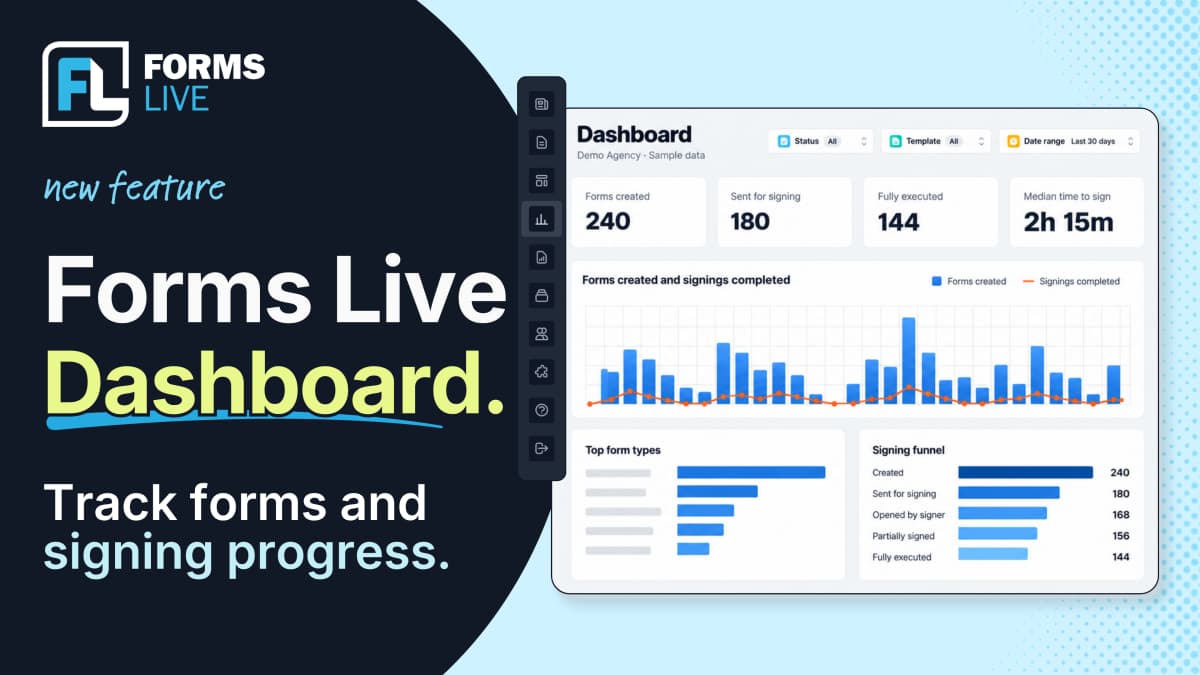
Forms Live Dashboard: Track Forms and Signing Progress
Explore the Forms Live Dashboard for Australian agencies. Track form data, monitor signing progress and compare agent activity in one place.


4 min read

Do real estate agencies need AML software under Tranche 2? Learn how Australian property businesses can meet AUSTRAC compliance requirements before July 2026.

As Australia moves closer to the 1 July 2026 implementation of Tranche 2 AML reforms, real estate agencies and conveyancing firms are asking a practical question: Is AML software actually necessary, especially for small or medium agencies?
The short answer is that while legislation does not explicitly mandate software, the operational reality of complying with Australia’s Anti-Money Laundering and Counter-Terrorism Financing (AML/CTF) reforms makes technology increasingly difficult to avoid.
In this guide, we explore what Tranche 2 requires in practical terms, whether manual compliance is realistic, the risks of partial compliance, how integrated platforms simplify the process, and what to look for when evaluating AML software for your property business.
Under AUSTRAC’s expanded AML/CTF regulations, from 1 July 2026, real estate agents and conveyancers providing designated services must implement a structured compliance framework.
In practice, this means:
The key component underpinning all of these obligations is demonstration. AUSTRAC expects businesses not simply to comply, but to prove that a genuine and reasonable attempt was made. Documentation, consistency, and audit readiness are central to that framework.
From a purely legal standpoint, yes, small agencies can manually manage AML compliance obligations.
There’s no clause within the legislation stating that compliance must be automated. However, once businesses evaluate the practical reality of executing their AML program, manual compliance becomes increasingly complex.
Manually managing AML requires maintaining details risk assessment records, securely storing identity documentation, tracking beneficial ownership information, checking sanctions lists individually, monitoring transactions for red flags, maintaining escalation logs, and preparing regulatory reports within strict deadlines, all consistently, and all retrievable on demand for audit purposes.
For agencies without dedicated compliance staff, this workload can become burdensome fast. Administrative time increases, client onboarding slows, and the risk of inconsistencies grows. Reporting deadlines may be missed simply because tracking systems are fragmented or reliant on manual reminders.
Manual processes also increase exposure during independent reviews or regulatory scrutiny. Incomplete, inconsistent or difficult-to-retrieve documentation isn’t simply an operational issue, with these inefficiencies becoming a compliance risk.
One of the most significant risks for property businesses under Tranche 2 is incomplete or partial compliance.
Common risks include:
AML is not a one-off checklist. It is a continuous framework that must operate consistently across the entire lifecycle of each client relationship.
Technology plays a critical role in reducing the risk of missed components, with automated systems are designed to ensure required steps aren’t overlooked and time-sensitive obligations are flagged appropriately.

Dedicated AML software platforms designed for Australian small and medium enterprises provide structured, end-to-end compliance support aligned with AUSTRAC requirements.
Rather than relying on disconnected systems, these platforms offer:
For property professionals, the real value lies in consistency. Software reduces human error, ensures required steps are completed in the right order, and creates a transparent audit trail that can withstand regulatory scrutiny.
Platforms such as easyAML, AMLHUB, and First AML are purpose-built for Australian AML/CTF requirements and are designed with the operational realities of real estate agencies in mind.
AML software alone is not the complete solution.
If compliance processes sit separately from everyday operational workflows, friction can quickly arise. When teams are under pressure to finalise listings, manage settlements or onboard new clients quickly, compliance steps that feel external to the workflow may be bypassed or delayed.
This is where workflow integrations become critical.
Platforms such as Forms Live make it possible for dedicated AML providers to integrate directly with forms and onboarding workflows, so CDD is initiated as part of the process itself as opposed to an additional step after the fact. Role-based task management ensures responsibilities are clearly allocated, and principals and compliance officers gain real-time visibility over compliance status across the business.
Instead of adding complexity, integration embeds AML into daily operations, where compliance becomes part of how your agency operates, not as a separate administrative layer.
While legislation does not mandate the use of specific software, the practical requirements of Tranche 2 (ongoing monitoring, timely reporting, detailed record retention and independent reviews) make manual systems increasingly difficult to sustain at scale.
For small and medium agencies without in-house compliance teams, AML software significantly reduces regulatory risk. It also improves efficiency by minimising duplication, centralising documentation and streamlining reporting processes.
In many cases, the question is less about whether software is legally required and more about whether manual compliance is operationally sustainable in the long term.
When evaluating AML software solutions, real estate agencies should prioritise:
Adopting technology early provides time for internal training, process refinement, and system testing before the compliance deadline arrives.
From 1 July 2026, real estate agents and conveyancers will operate under Australia’s formal AML/CTF framework. The obligations are mandatory, but the chaos is optional.
When structured risk assessments, clearly defined roles, automated CDD, ongoing monitoring and integrated workflow tools operate together, AML shifts from regulatory burden to operational clarity.
The agencies that begin preparing now will enter July 2026 with tested systems, trained staff and significantly less stress. The goal isn’t simply meeting minimum requirements, but it’s building a sustainable compliance framework that protects both your business and upholds the integrity of the property market.
Not sure where to start? We’ve put together a practical AML Essentials Checklist to help real estate agents and conveyancers track their compliance preparation step by step.
Download the Free AML Essentials Checklist →
No sign-up required. Just a clear, practical guide to help you move from chaos to clarity before 1 July 2026.
Is AML software mandatory for real estate agents under Tranche 2? The legislation does not explicitly require specific software. However, the practical obligations of Tranche 2 (including ongoing CDD, monitoring, SMR lodgement, and audit-ready record keeping) make manual-only compliance difficult to sustain for most agencies, particularly those without dedicated compliance staff.
What does AML software do for property businesses? AML software automates Customer Due Diligence (KYC and KYB), Ultimate Beneficial Owner identification, sanctions and PEP screening, ongoing transaction monitoring, SMR preparation, and centralised record storage, reducing manual workload and compliance risk.
When do real estate agencies need to be compliant with Tranche 2? From 1 July 2026, real estate agencies and conveyancers providing designated services must comply with Australia’s AML/CTF reforms administered by AUSTRAC. AUSTRAC enrolment opened 31 March 2026.
What is the difference between VOI and CDD? Verification of Identity (VOI) confirms who a person is. Customer Due Diligence (CDD) goes further as it verifies identity, identifies beneficial owners, assesses risk, understands the purpose of the transaction, and requires ongoing monitoring. From 1 July 2026, VOI alone will not satisfy AML obligations.
What are Suspicious Matter Reports (SMRs)? SMRs are mandatory reports lodged with AUSTRAC when a business forms a suspicion that a transaction may involve money laundering or terrorism financing. Real estate businesses must lodge SMRs within three business days of forming a suspicion, or within 24 hours if terrorism financing is suspected.
For an introduction to the AML/CTF reforms, watch our AML webinar.
The Forms Live platform is the leading provider of forms and contracts for the real estate industry around Australia and is owned by Dynamic Methods. It is used by 8,500 real estate agencies and more than 50,000 agents and property managers. More than 70 million of our forms have been used since launch in 2005 resulting in more than $100m in property sales per month and a further $80m in property leases per month.
Explore the Forms Live Dashboard for Australian agencies. Track form data, monitor signing progress and compare agent activity in one place.
4 min read

A practical overview of the new property sales and underquoting requirements, key dates and what Victorian agencies should prepare for.
7 min read

Generate a unique QR code for each open home so attendees can register on their phone in seconds, then download the complete attendee list after the event.
3 min read